
Thai culture
Living in Bangkok While Learning Thai Cooking: What to Expect

Apr
Living in Bangkok While Learning Thai Cooking: What to Expect
There is a moment that happens to almost every culinary student during their first week in Bangkok. You are standing at a market stall before 7am, watching a vendor ladle a clear, fragrant broth over rice noodles with the kind of effortless precision that only comes from decades of practice. The city is already fully alive around you — motorcycles threading through traffic, monks collecting alms in the early light, the smell of charcoal and jasmine garlands drifting through the air. And it occurs to you that the cooking school Bangkok experience you signed up for extends far beyond any classroom.
Bangkok does not simply provide a backdrop for culinary education. It is the education. For students committed to understanding Thai cuisine at its source, life in this city is immersive, generous, and genuinely transformative.
A City That Feeds You at Every Turn
Food as the Pulse of Bangkok Life
Bangkok is one of the few cities in the world where food is not just abundant — it is omnipresent. There is no hour of the day when something worth eating cannot be found within a short walk. Breakfast vendors serve joke (rice congee) and patongo (fried dough) from before dawn. Lunch is a relaxed, social affair eaten at shophouse restaurants or at plastic tables on the pavement. The afternoon brings fresh-cut fruit carts and sweet vendors selling khanom (Thai sweets) wrapped in banana leaves. By night, entire streets transform into markets blazing with light and smoke.
For life in Bangkok for students of Thai cuisine, this constant availability of authentic, affordable, and varied food is an education that runs parallel to everything happening inside the kitchen. Every meal eaten on the street is a reference point — a benchmark of balance, seasoning, and technique against which your own cooking can be measured.
Navigating the City as a Student
Bangkok is a large, sprawling metropolis, but for students it is far more manageable than it first appears. The BTS Skytrain and MRT metro system connect the city’s key neighborhoods efficiently, and river taxis on the Chao Phraya offer a slower, more scenic alternative. Neighborhoods popular with international students — Silom, Sukhumvit, Ari, and the riverside areas near Charoen Krung — offer a mix of affordable accommodation, cafés, co-working spaces, and excellent local food within easy reach of cooking schools and cultural sites.
Accommodation ranges from international-standard serviced apartments to modest but comfortable guesthouses in more traditional neighborhoods. The cost of living is genuinely low by global standards, making it possible to eat exceptionally well, live comfortably, and still have resources for the cultural exploration that enriches your time in the city.

The Markets: A Culinary Student's Second Classroom
Understanding Ingredients at Their Source
No understanding of Thai cooking is complete without a deep familiarity with Thai ingredients, and no place develops that familiarity faster than Bangkok’s markets. They are, for any serious culinary student, an essential destination.
Or Tor Kor Market, adjacent to Chatuchak in the north of the city, is widely considered the finest quality fresh market in Bangkok. Its stalls carry an extraordinary variety of produce — ripe mangosteens and rambutans displayed with near-jeweler-like precision, fresh-grated coconut prepared to order, aromatic pastes ground daily, and regional specialties not easily found elsewhere in the city. Visiting here teaches students to recognize quality: the firm flesh of a good galangal root, the deep green of fresh kaffir lime leaves, the correct ripeness of a tamarind pod.

Khlong Toei Market, by contrast, is raw and unfiltered — Bangkok’s largest wet market, operating in the earliest hours of the morning and supplying many of the city’s professional kitchens. The sheer scale and intensity of Khlong Toei is instructive in itself. Watching wholesale chefs and restaurant buyers select their daily ingredients here offers a window into the professional side of Thai food culture that few tourists ever see.
For students at Bangkok Thai Cooking Academy, market literacy is not a peripheral skill. It is central to the culinary education, shaping an understanding of seasonality, regionality, and the relationship between ingredient quality and final dish quality.

Tip: Visit the Market Before Class
If your schedule allows, visiting a market on the morning of a cooking class adds remarkable depth to the experience. Handling the raw ingredients before cooking with them — smelling the difference between fresh and dried shrimp paste, feeling the resistance of a green papaya before grating — creates a sensory memory that makes in-class instruction click in a completely different way.
Inside the Cooking School Bangkok Experience
The Structure of Professional Thai Culinary Training
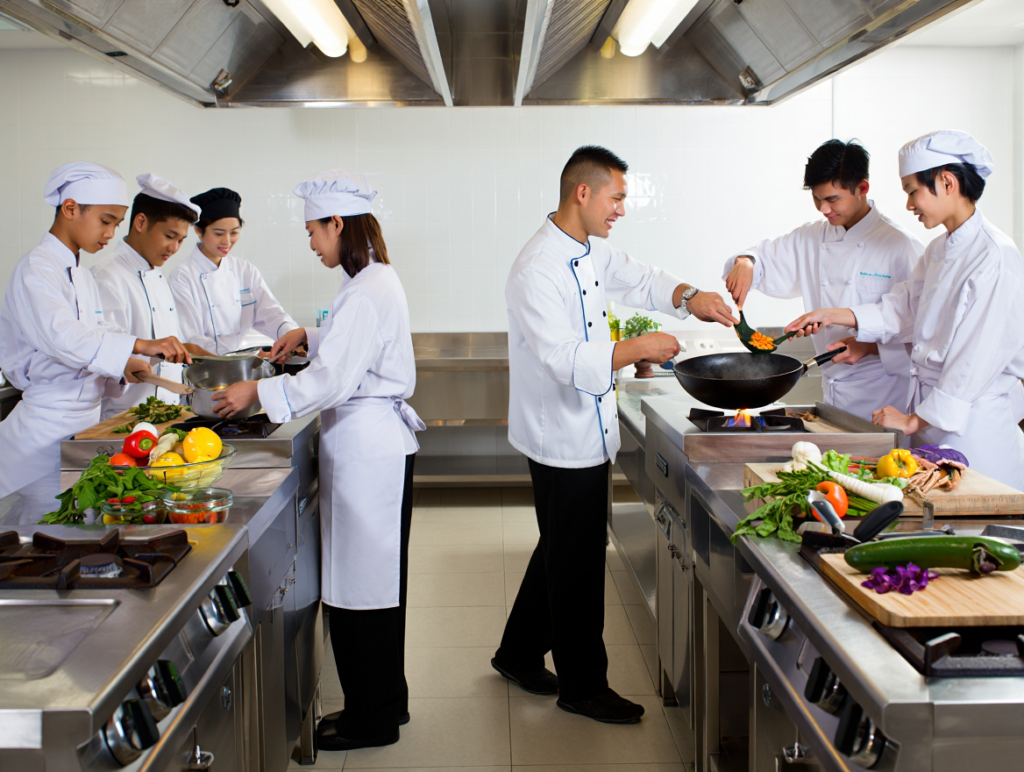
A Bangkok Thai class at Bangkok Thai Cooking Academy is structured around the kind of professional seriousness that its Worldchefs accreditation demands. This is not a drop-in tourist activity. It is a curriculum-driven culinary education that builds skills progressively, situates technique within cultural context, and prepares students for the realities of professional kitchens.
A typical study day begins with ingredient exploration. Before a single wok is heated, students examine, smell, taste, and discuss what they will be working with. Why is this particular variety of Thai basil used in a stir-fry rather than the holy basil that goes into pad kra pao? What does the ratio of fish sauce to palm sugar tell you about the regional origin of a dish? These questions are not incidental — they are the intellectual core of a rigorous culinary education.
Hands-on cooking sessions follow, working in small groups under the direct guidance of experienced Thai chef instructors. Feedback is specific, immediate, and professionally calibrated. The goal is not to produce a passable version of a dish for personal satisfaction, but to understand and replicate authentic technique with genuine competence.
Learning from Culture, Not Just Recipes
What distinguishes the cooking school Bangkok experience at Bangkok Thai Cooking Academy from culinary education in almost any other country is the living cultural context surrounding it. Thai cuisine did not emerge from a vacuum — it is the product of geography, trade, religion, royal tradition, and centuries of regional evolution. Learning about it in Bangkok, surrounded by its living context, makes that history tangible.
A lesson on massaman curry, for example, becomes a conversation about the Persian and Indian Muslim traders who brought warming spices to the Gulf of Thailand centuries ago, and how Thai cooks adapted those influences into something entirely their own. A session on Northern Thai cooking opens a window into the distinct Lanna cultural tradition that sets Chiang Mai’s cuisine apart from Bangkok’s. This depth of context is only available when you are actually here, inside the culture.
Life Beyond the Kitchen
Bangkok’s Cultural Richness for the Curious Student
Life in Bangkok for students is not confined to kitchens and markets. The city offers a cultural richness that rewards curiosity at every turn. The historic center around Rattanakosin Island holds some of Southeast Asia’s most magnificent architecture — the Grand Palace, Wat Pho with its monumental reclining Buddha, and Wat Arun rising dramatically from the bank of the Chao Phraya. The city’s contemporary art scene, centered on spaces like BACC (Bangkok Art and Culture Centre) and a growing network of independent galleries, reflects a creative energy that is reshaping Bangkok’s international identity.
For culinary students, cultural engagement feeds directly into professional understanding. Thai Buddhist traditions shape the way food is offered, shared, and understood. Regional festivals alter what is eaten and how. Even the layout of a traditional Thai meal — several dishes served simultaneously rather than in sequence, designed for communal sharing — reflects a social philosophy that has everything to do with hospitality and reciprocity.
Building Community and Belonging
One of the underappreciated aspects of life in Bangkok for students is how naturally community forms. Bangkok’s substantial international population — students, expatriates, digital nomads, and long-term travelers — creates a social environment in which meeting interesting, like-minded people is straightforward. Cooking school cohorts develop their own tight bonds, forged over shared meals, market mornings, and the particular camaraderie that comes from learning something difficult together.
Evenings after class often become informal food expeditions — a group of students navigating the alleyways of a neighborhood night market, debating the merits of competing pad thai vendors, or sitting by the river with a Chang beer and a plate of grilled chicken. These moments are as much a part of the education as anything that happens with a knife and a cutting board.
