
Thai culture
Top Thai Dishes You Will Learn in a Professional Cooking School in Bangkok

Apr
Top Thai Dishes You Will Learn in a Professional Cooking School in Bangkok
Ask ten food lovers to name a dish that changed the way they think about cooking, and a remarkable number of them will name something Thai. A green curry that somehow holds fire and creaminess in perfect suspension. A bowl of tom yum that makes every nerve ending in your mouth pay attention simultaneously. A plate of pad thai that, when made properly, bears almost no resemblance to the takeaway version you grew up with. Thai cuisine has this effect on people — it does not just satisfy hunger, it resets expectations.
For those who decide to pursue Thai culinary training seriously, the question quickly becomes: where do you begin, and what will you actually learn? A professional cooking school in Bangkok does not simply hand you a recipe and a wok. It builds your understanding dish by dish, technique by technique, until the logic of Thai cuisine becomes instinctive. Below is a guide to the essential dishes that anchor any serious Thai cooking course — and what each one teaches you about the cuisine as a whole.
The Foundation Dishes: Where Every Thai Cooking Course Begins
Pad Thai — The Dish That Teaches You Everything About the Wok
Pad Thai is perhaps the most internationally recognized Thai dish, which makes it easy to underestimate. In professional Thai culinary training, it is treated with the seriousness it deserves — because cooking pad thai well is genuinely difficult, and cooking it correctly reveals the foundational principles of Thai stir-fry technique.
The dish is built on rice noodles stir-fried over very high heat with egg, tofu or shrimp, bean sprouts, and spring onions, finished with a tamarind-based sauce and served with crushed peanuts, dried chili flakes, and a wedge of lime. Every component is straightforward. The challenge lies entirely in execution: heat management, timing, and the precise moment at which each ingredient enters the wok.
What pad thai teaches is wok discipline — the ability to work at high temperature without losing control of the dish. Professional Thai culinary training uses pad thai as an entry point into wok cookery precisely because its relative simplicity makes technique the only variable. When students can produce a proper pad thai — noodles with the right texture, sauce balanced between sweet, sour, and salty, egg properly incorporated — they have demonstrated a foundational wok competence that underpins dozens of other dishes.
The History Behind the Dish
Pad thai’s origins are more recent than most people assume. The dish was actively promoted by the Thai government in the 1930s and 1940s as part of a national identity campaign, chosen partly because it used rice noodles rather than wheat — a way of conserving rice during periods of scarcity. A dish that feels timeless is, in fact, a product of deliberate political and cultural engineering. Understanding this history deepens a student’s relationship with the dish considerably.
Soups and Broths: The Soul of Thai Culinary Training
Tom Yum Goong — Mastering the Hot and Sour
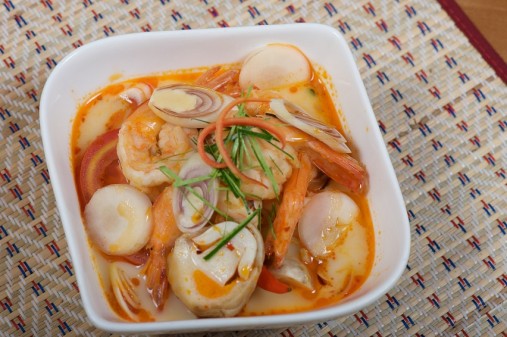
Tom yum goong — the iconic hot and sour prawn soup — is one of the defining achievements of Thai cuisine and an essential component of any serious Thai cooking course. Its flavor profile is aggressive and unambiguous: the sharp heat of bird’s eye chilies, the citrus perfume of lemongrass and makrut lime leaves, the sour brightness of fresh lime juice, the deep savory foundation of fish sauce and galangal. Every element must be present, and every element must be in balance.
What tom yum teaches in professional Thai culinary training is the art of building a broth from aromatics — understanding how heat extracts flavor from lemongrass and galangal differently than from herbs added at the end, and how the sequence of additions shapes the final profile of a dish. Students also learn the critical distinction between tom yum nam sai, the clear broth version, and tom yum nam khon, enriched with evaporated milk or coconut cream — two expressions of the same dish with markedly different characters.
Tom Kha Gai — Coconut, Galangal, and the Art of Restraint
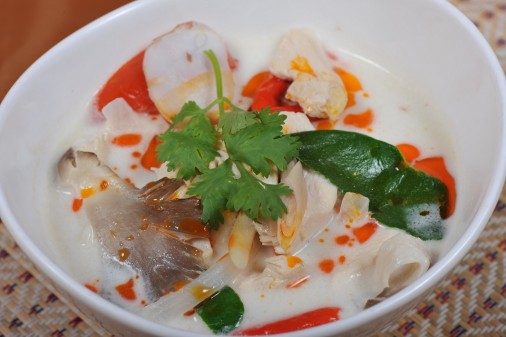
If tom yum is assertive, tom kha gai is its gentler, more meditative counterpart. This coconut milk soup with chicken, galangal, lemongrass, and mushrooms is a lesson in subtlety — in how aromatic ingredients can be coaxed rather than forced, and how the creamy richness of coconut milk can carry heat and acidity without being overwhelmed by them.
Tom kha gai is also a lesson in the unique character of galangal — a rhizome so central to Thai cooking that it cannot be substituted without fundamentally altering a dish. In professional Thai culinary training, students learn to recognize and work with galangal as a distinct ingredient in its own right, understanding its cooling, almost medicinal quality and how it interacts with the fat in coconut milk to create tom kha’s characteristic depth.
Curry: The Technical Heart of Thai Cuisine
Green Curry — Building a Paste from Scratch
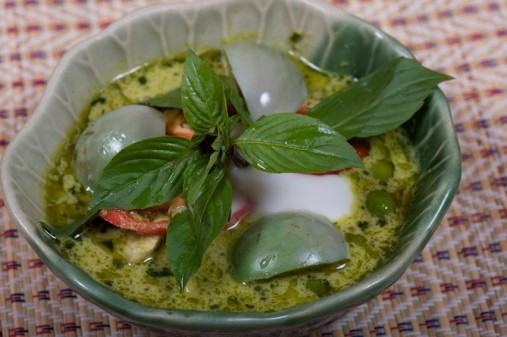
Of all the dishes on a Thai cooking course, green curry (gaeng keow wan) is perhaps the most technically demanding and the most instructive. It begins not with a jar or a packet but with a mortar and pestle and a collection of fresh aromatics — green chilies, lemongrass, galangal, shallots, garlic, coriander root, makrut lime zest, and shrimp paste — that must be pounded in careful sequence into a smooth, fragrant paste before a drop of coconut milk ever enters the pot.
The paste-making process is the core of green curry instruction in professional Thai culinary training. It teaches students that a Thai curry is not a sauce — it is an architecture, built ingredient by ingredient, each one contributing a specific dimension of flavor and aroma that cannot be replicated by a shortcut. The order of pounding matters. The degree of reduction of each component matters. The final paste should be intensely aromatic, cohesive, and complex in a way that makes the finished curry possible.
Once the paste is made, the cooking technique introduces a second set of skills: how to fry a curry paste in coconut cream to develop its flavor before adding liquid, how to assess the richness and consistency of the finished sauce, and how to balance the dish with fish sauce, palm sugar, and fresh Thai basil at the moment of finishing.
Red Curry and Massaman — Regional Variations, Deeper Understanding
A comprehensive Thai cooking course does not stop at green curry. Red curry (gaeng phet) uses dried red chilies as its base, producing a sauce that is earthier, more deeply colored, and with a different heat profile than green. Massaman curry, by contrast, draws on centuries of Persian and Indian Muslim culinary influence, incorporating warming dried spices — cinnamon, cardamom, cumin, cloves — that are entirely absent from central Thai curries.
Studying the range of Thai curries in professional Thai culinary training builds a sophisticated understanding of how Thai cuisine is not a single tradition but a family of regional and historical traditions, each with its own logic, ingredients, and cultural context.

Iconic Street Food Dishes: Everyday Thai Mastery
Pad Kra Pao — The Dish Thailand Eats Every Day
If pad thai is Thailand’s international ambassador, pad kra pao (stir-fried meat with holy basil) is what Thailand actually eats for lunch. Walk past any shophouse restaurant at noon and you will see it on almost every table: ground pork or chicken stir-fried at ferocious heat with garlic, bird’s eye chilies, oyster sauce, and fish sauce, finished with a generous handful of fresh holy basil and served over jasmine rice with a fried egg on top.
Pad kra pao is an essential inclusion in any Thai cooking course because it captures something central to Thai culinary identity — the idea that extraordinary flavor can be produced in under five minutes with minimal ingredients, provided the technique is correct and the heat is high enough. Students learn how to manage a very hot wok, how to bloom garlic and chilies in oil before adding protein, and how the holy basil — added only at the last possible moment — wilts into the dish without losing its aromatic integrity
Som Tum — Understanding the Flavor Architecture of Thai Salads
Som tum, the green papaya salad of the northeastern Isaan region, is one of the most significant dishes in the entire Thai canon — and one of the most illuminating to learn. Made in a mortar with shredded unripe papaya, tomatoes, green beans, peanuts, dried shrimp, fish sauce, palm sugar, lime juice, and chilies, it is an exercise in building flavor in real time, adjusting seasoning with each pound of the pestle until every element is in balance.
What makes som tum so valuable in Thai culinary training is that it makes the four-flavor philosophy of Thai cuisine completely visible. There is nowhere to hide. The sweet, sour, salty, and spicy dimensions of the dish are all present and adjustable, and students must learn to taste critically and correct deliberately — a skill that transfers to every other Thai dish they will ever cook.
Thai Desserts: The Sweet Dimension of Professional Training
Mango Sticky Rice and the Art of Coconut Sweetness
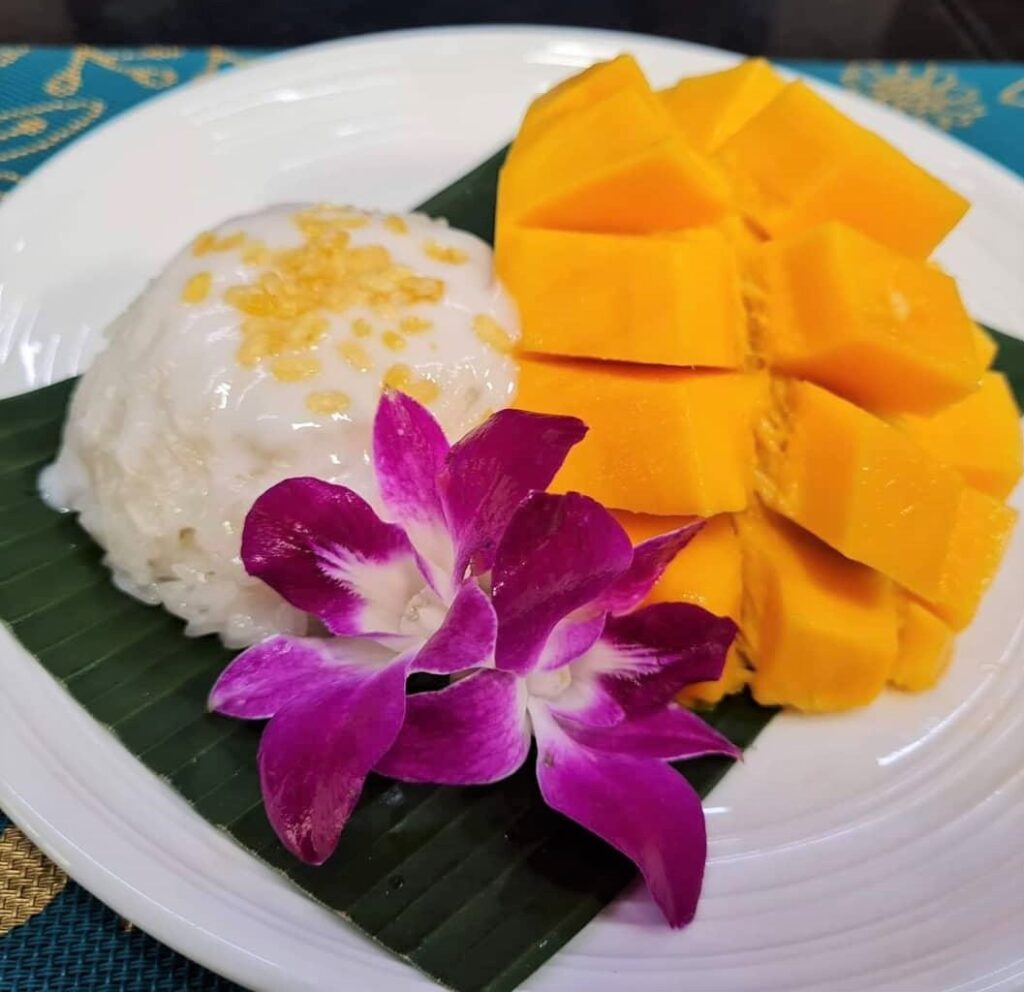
No Thai cooking course at a professional level is complete without serious engagement with Thai desserts, and mango sticky rice (khao niao mamuang) is the natural starting point. Deceptively simple in concept — glutinous rice steamed and dressed with sweetened coconut milk, served alongside slices of ripe Thai mango — it is technically precise in execution.
The glutinous rice must be soaked, steamed correctly until tender but not mushy, and dressed with coconut sauce at exactly the right moment so that the rice absorbs rather than sits in the liquid. The coconut sauce itself must be seasoned with just enough salt to amplify its sweetness — a principle that appears throughout Thai dessert cookery and that surprises many students encountering it for the first time.
Beyond mango sticky rice, professional Thai culinary training introduces students to the extraordinary range and refinement of Thai sweets — from pandan-scented coconut jellies to the lacquer-bright golden threads of foi thong, a dessert with Portuguese roots that has been practiced in Thai royal kitchens for four centuries.
The dishes outlined above are not simply a menu — they are a map of Thai cuisine’s essential principles, techniques, and cultural depth. Each one teaches something specific: wok discipline, broth architecture, paste construction, flavor balance, the precision of Thai dessert work. Together, they form the foundation of a culinary education that is both practically rigorous and culturally profound.
At Bangkok Thai Cooking Academy, these dishes are taught within a structured, Worldchefs-approved professional curriculum that takes students from foundational skills to advanced competence — in the city where Thai cuisine is most alive, most authentic, and most generously available at every street corner and market stall.
If you are ready to learn these dishes properly — not from a recipe card but from expert Thai chef instructors in a professional kitchen in Bangkok — explore the Thai cooking courses at Bangkok Thai Cooking Academy and take the first step toward cooking Thai food the way it was meant to be cooked.
