
Masterclass
Bangkok Fresh Market Ingredients: What Chefs Look for Before Cooking

Oct
What a Thai Chef Sees That You Don’t: The Art of Reading a Bangkok Fresh Market?
A Bangkok fresh market at seven in the morning is one of the most sensory-rich environments on earth. The smell hits you first — a layered combination of lemongrass, fish sauce, ripe mango, fresh chilies, and the particular damp earthiness of freshly cut galangal. Then the color: deep purple Thai basil beside pale green kaffir lime leaves, vivid orange turmeric roots stacked next to bundles of coriander still wet from the morning’s harvest. And the sound — vendors calling out prices, the rhythmic thud of a cleaver on a wooden block, the hiss of a wok at a nearby food stall already feeding the first customers of the day.
For a tourist walking through this environment, it is overwhelming and extraordinary in equal measure. For a trained Thai chef, it is a classroom — one that teaches something new on every visit. Professional cooks move through Bangkok’s fresh markets with a specific, practiced eye, evaluating each ingredient against a set of criteria that most people have never been taught to consider. The color of a galangal root, the fragrance of a Thai basil bunch, the firmness of a kaffir lime, the moisture level of a dried chili — these details determine not just the quality of the ingredients but the flavor and character of everything cooked with them.
Understanding what Bangkok fresh market ingredients professional chefs look for — and why — is one of the most direct paths to understanding how Thai cuisine actually works. And it is exactly what the Thai market tour included in Bangkok Thai Cooking Academy’s classes is designed to teach.
The Essential Ingredients Every Thai Chef Evaluates at the Market
Galangal: The Root That Defines the Thai Flavor Profile
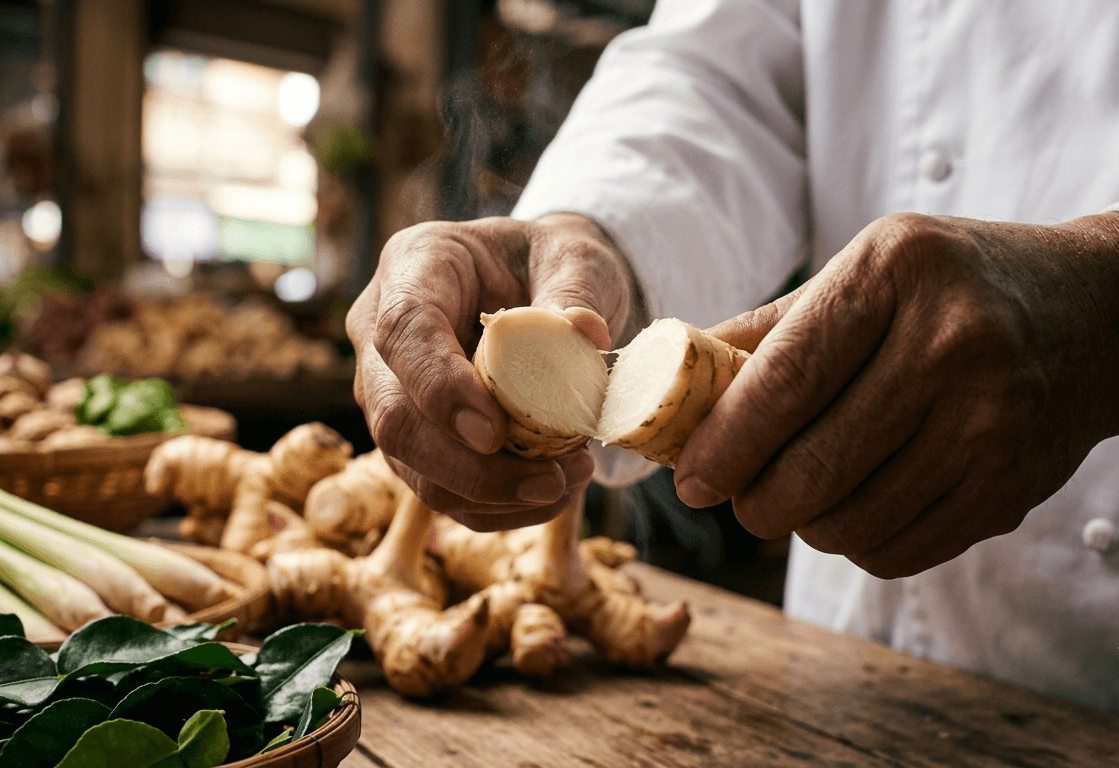
Galangal (kha in Thai) is one of the most important and most misunderstood ingredients in Thai cooking. It looks superficially similar to ginger — to which it is related — but its flavor is entirely different: piney, citrusy, medicinal, with a sharpness that ginger lacks entirely. In Thai cooking, galangal is not a substitute for ginger and ginger is not a substitute for galangal. They are distinct ingredients with distinct roles, and confusing them produces a dish that tastes wrong in ways that are difficult to articulate but immediately obvious.
When a professional Thai chef examines galangal at a Bangkok market, they are looking for several things simultaneously. The skin should be smooth and taut, not wrinkled or dried out. The flesh should be dense and firm — soft or spongy galangal has lost moisture and much of its essential oil content, which means it will contribute less fragrance to a curry paste. The color of the cut surface should be a clean, pale cream or very light pink. And the smell, when the root is snapped, should be immediately sharp and aromatic — a clear signal that the volatile compounds responsible for its flavor are still fully present.
Galangal is the backbone of tom kha gai (chicken in coconut milk), a dish that appears in the Thursday Northern Thai Kitchen Masterclass at Bangkok Thai Cooking Academy, alongside Khao Soi and Nam Tok Beef — all dishes where galangal’s contribution to the flavor base is structural, not decorative.
Lemongrass: Fragrance, Freshness, and the Test of the Thumb
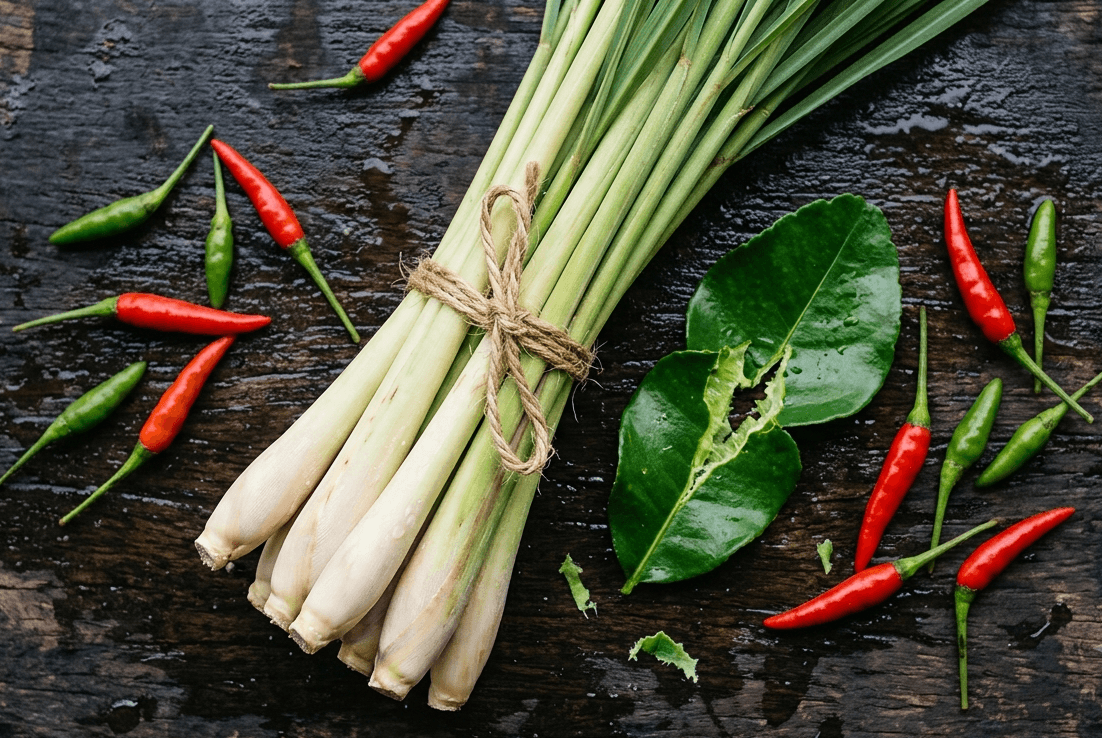
Lemongrass (ta-khrai) is another ingredient that appears in almost every Thai curry paste and many Thai soups, and whose quality at the market has a direct and significant impact on the finished dish. The difference between fresh lemongrass at peak condition and lemongrass that has been sitting in a refrigerator for a week is not subtle — it is the difference between a curry paste that smells alive and vibrant and one that smells flat and faintly musty.
Professional Thai chefs evaluate lemongrass primarily by smell and by texture. The lower portion of the stalk — the part that goes into curry paste — should be firm and tightly packed, with a pale, almost white color. The outer leaves should be dry but not brittle, and the stalk should not feel hollow when pressed. Most importantly, bending or bruising a small section of the stalk and smelling the exposed surface should release an immediate, bright citrus fragrance. If that fragrance is faint or absent, the lemongrass has lost the essential oils that make it valuable.
In the Bangkok Thai Cooking Academy Thai Cooking Masterclass, students make curry pastes from scratch every day — Red Curry on Monday, Green Curry on Tuesday, Massaman on Wednesday, Khao Soi on Thursday, Penang on Friday — and lemongrass is a core component of all five. Understanding how to select lemongrass at the market is the first step in understanding why each of these pastes has the flavor profile it does.
Kaffir Lime Leaves: The Ingredient That Cannot Be Substituted
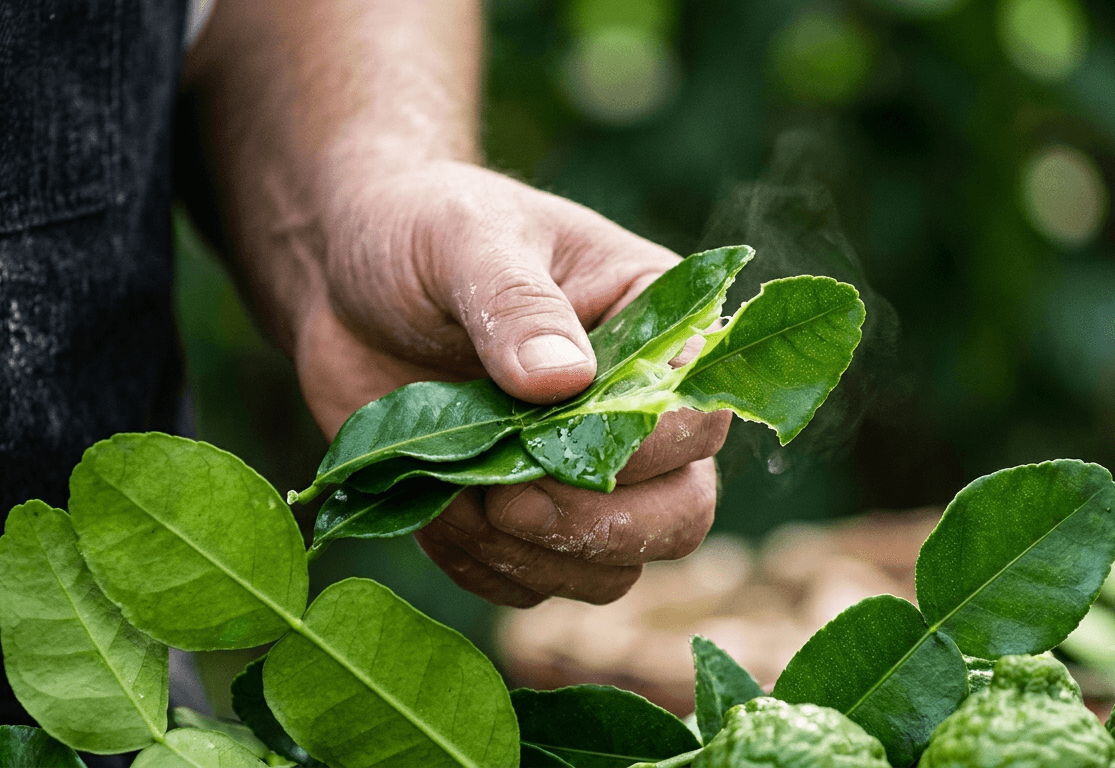
Kaffir lime leaves (bai makrut) are one of the most distinctive aromatics in Thai cuisine — and one of the most difficult to source at full quality outside of Thailand. The double-lobed leaf has a fragrance that is simultaneously floral, citrusy, and slightly bitter, with a depth that dried leaves or bottled substitutes simply cannot replicate. In Thailand, fresh kaffir lime leaves are available at every fresh market, and professional chefs know exactly what to look for.
The leaves should be a deep, glossy green on the upper surface — not yellowing, not spotted, not limp. They should feel firm and slightly waxy between the fingers. When a single leaf is torn in half, the fragrance released should be immediate and intense — a sharp, bright citrus-floral note that is entirely distinctive. Pale or yellowing leaves, or leaves that release only a faint smell when torn, have been stored too long and will contribute far less to the finished dish.
In Thai cooking, kaffir lime leaves appear in curry pastes, in soups like Tom Kha Gai, and as a finishing garnish sliced into fine chiffonade — each application drawing on a different aspect of the leaf’s complex fragrance profile.
The Difference Between Kaffir Lime Leaves and Kaffir Lime Fruit
The kaffir lime tree produces both leaves and fruit, and both are used in Thai cooking — but in different ways. The leaves provide fragrance and are used extensively throughout the cooking process. The rind of the kaffir lime fruit (makrut) — highly aromatic and intensely flavored — is used specifically in curry paste preparation, where it is grated or pounded with the other aromatic ingredients. The juice of the kaffir lime, by contrast, is rarely used in cooking because of its extreme bitterness. Understanding the distinction between these two components of the same ingredient is the kind of nuanced knowledge that a market tour with a professional instructor delivers in minutes.
Thai Chilies: Heat, Color, and the Logic of Variety
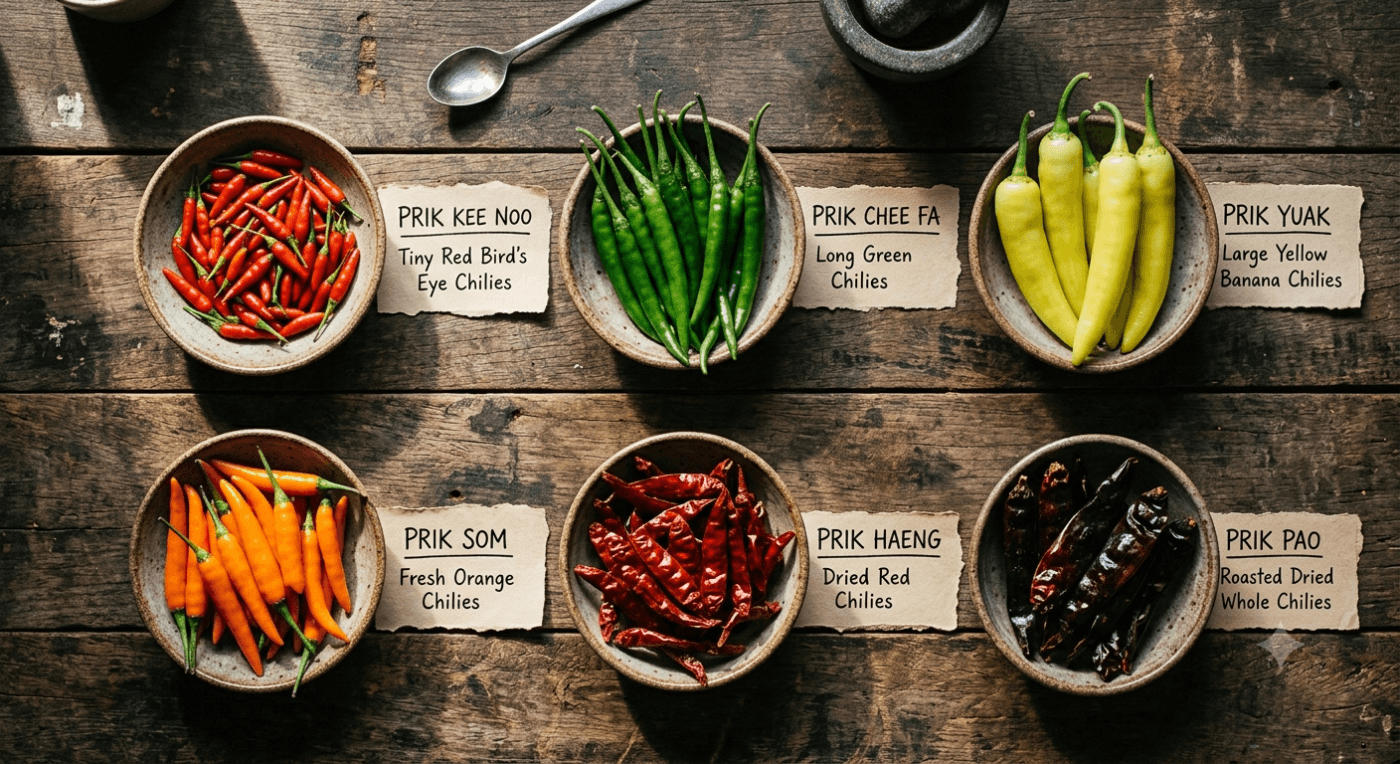
Thai cuisine uses a remarkable range of chili varieties, each with its own heat level, flavor profile, and culinary application. Walking through a Bangkok fresh market with a professional Thai chef reveals that what most visitors see as simply “chilies” is actually a complex vocabulary of distinct ingredients — and choosing the right variety for each dish is one of the foundational skills of Thai cooking.
Prik kee noo (bird’s eye chilies) are the small, intensely hot chilies used fresh in dishes like papaya salad and minced chicken with basil — the latter featured in the Wednesday Street Food Workshop Masterclass. Prik chee fa (long red or green chilies) are milder and are often used for their color as much as their heat. Prik haeng (dried red chilies) are the backbone of most Thai curry pastes, providing heat, color, and a slightly smoky, concentrated flavor that fresh chilies cannot replicate. And prik yuak (banana chilies) are mild and large, used in specific regional dishes and stir-fries.
Professional chefs select chilies based on the heat level required, the color needed for the finished dish, and the form — fresh, dried, or roasted — that the recipe demands. Dried chilies should be checked for even color, flexibility (they should bend without crumbling), and aroma. Fresh chilies should be firm and glossy, with no soft spots or discoloration at the stem.
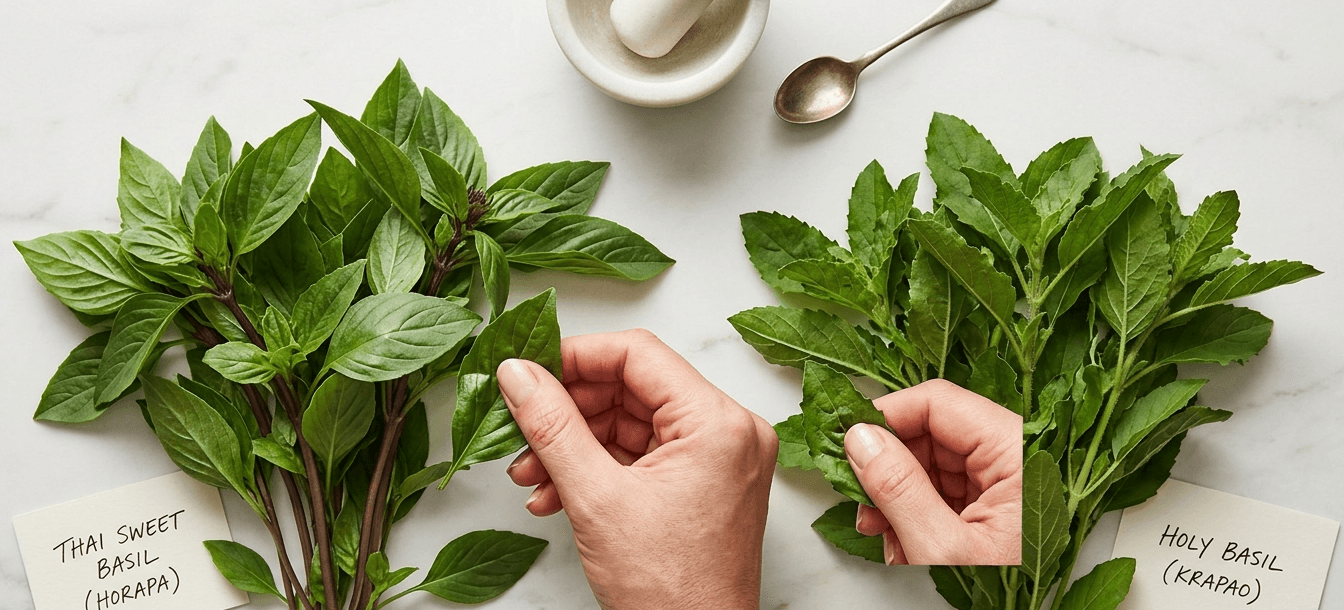
Thai Basil and Holy Basil: Two Ingredients That Are Not Interchangeable
The distinction between Thai basil (horapa) and holy basil (krapao) is one that surprises many visitors to Bangkok’s markets — and that matters enormously in the kitchen. Both are members of the basil family, but they look and taste quite different, and they are used in entirely different contexts in Thai cooking.
Thai basil (horapa) has smooth, glossy leaves with a slightly purple tinge at the stem and a flavor that combines sweet basil with anise and a faint licorice note. It is used in curries, added toward the end of cooking so that its fragrance is preserved. Holy basil (krapao) has slightly serrated leaves, a more matte surface, and a flavor that is peppery, clove-like, and almost medicinal — nothing like Italian basil, and nothing like Thai basil either. It is the essential ingredient in pad kra pao, the stir-fried minced meat with basil dish that is arguably Thailand’s most widely eaten everyday meal.
At the market, professional chefs evaluate both varieties primarily by freshness and fragrance. Leaves should be bright green, firm, and unblemished. The smell test — bruising a leaf gently between the fingers — should release an immediate, characteristic fragrance. Wilted or yellowing basil has lost much of its volatile oil content and will contribute far less flavor to the finished dish.
Why a Market Visit Changes Everything About How You Cook Thai Food
Learning Ingredients in Context, Not in Isolation
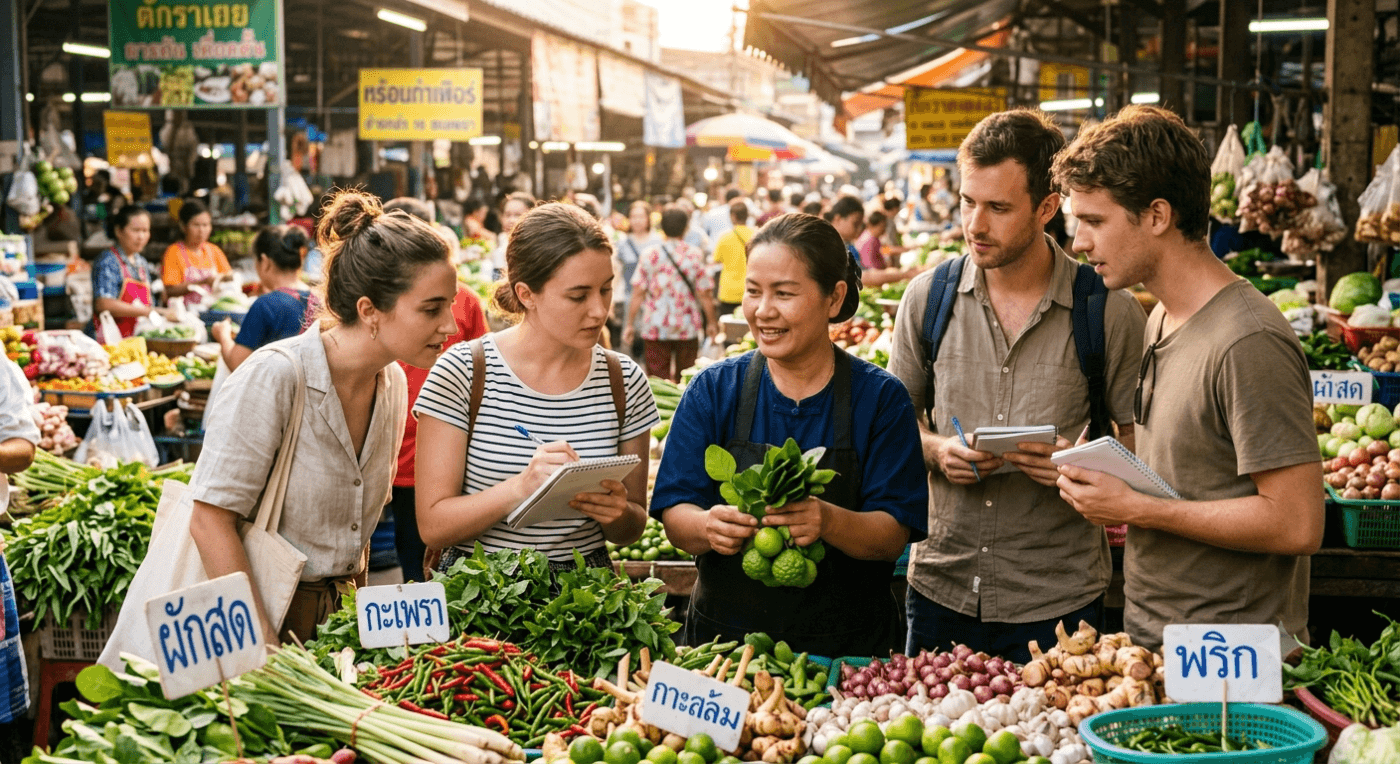
There is a significant difference between reading about Thai ingredients in a cookbook and encountering them at a Bangkok fresh market with a professional Thai chef explaining what you are seeing, smelling, and touching. The market visit that is included in every Bangkok Thai Cooking Academy Masterclass is not a tourist activity — it is the first lesson of the cooking class, designed to give students the ingredient knowledge they need to understand everything that follows in the kitchen.
When a student holds a bundle of lemongrass, bends a dried chili, tears a kaffir lime leaf, and smells the cut surface of a fresh galangal root — all within the context of a market visit led by an experienced Thai chef — the abstract becomes concrete. The ingredients stop being items on a shopping list and become living, sensory realities with specific qualities that matter to the outcome of the dish.
This is precisely the approach taken in the Thai Cooking Masterclass at Bangkok Thai Cooking Academy — a premium, chef-led, small-group cooking experience with a maximum of eight students per class, where every session begins with a Thai fresh market visit and ends with a full meal of dishes prepared from scratch using the ingredients students have learned to select and evaluate.
What Students Take Home Beyond the Recipes?
The most lasting benefit of learning to cook at a Bangkok fresh market is not a specific recipe — it is a transferable skill. Once a cook knows what fresh galangal should smell like, what quality lemongrass feels like in the hand, and how to distinguish holy basil from Thai basil by fragrance rather than appearance, that knowledge travels home with them. It changes how they shop at Asian grocery stores, how they evaluate ingredients, and how confident they feel attempting Thai recipes in their own kitchen. The market visit is not a preamble to the cooking class — it is its foundation.
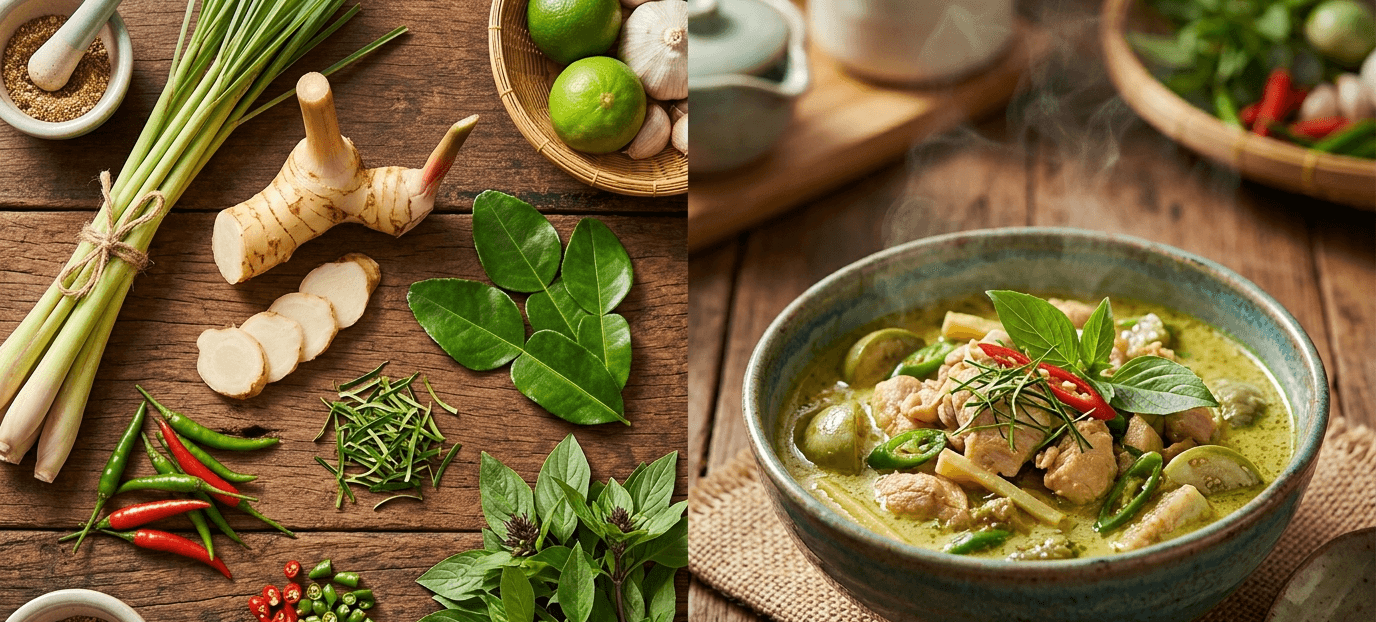
Bangkok’s fresh markets are not simply places to buy food. They are the living foundation of Thai cuisine — the point at which the quality of every dish is determined before the wok is even heated. Learning to read a market the way a professional Thai chef does is one of the most valuable culinary skills a food lover can acquire, and Bangkok is the only place in the world where that education can be delivered in its full, authentic context.
At Bangkok Thai Cooking Academy, the Thai market tour is a core part of every Masterclass experience — not an optional extra, but an integral lesson in the ingredient knowledge that makes great Thai cooking possible. Whether you join for a single session or commit to the five-day Certificate Course, the market visit is where your understanding of Thai cuisine truly begins.
Book your Thai Cooking Masterclass in Bangkok and discover what professional Thai chefs look for before they ever turn on the heat.
